
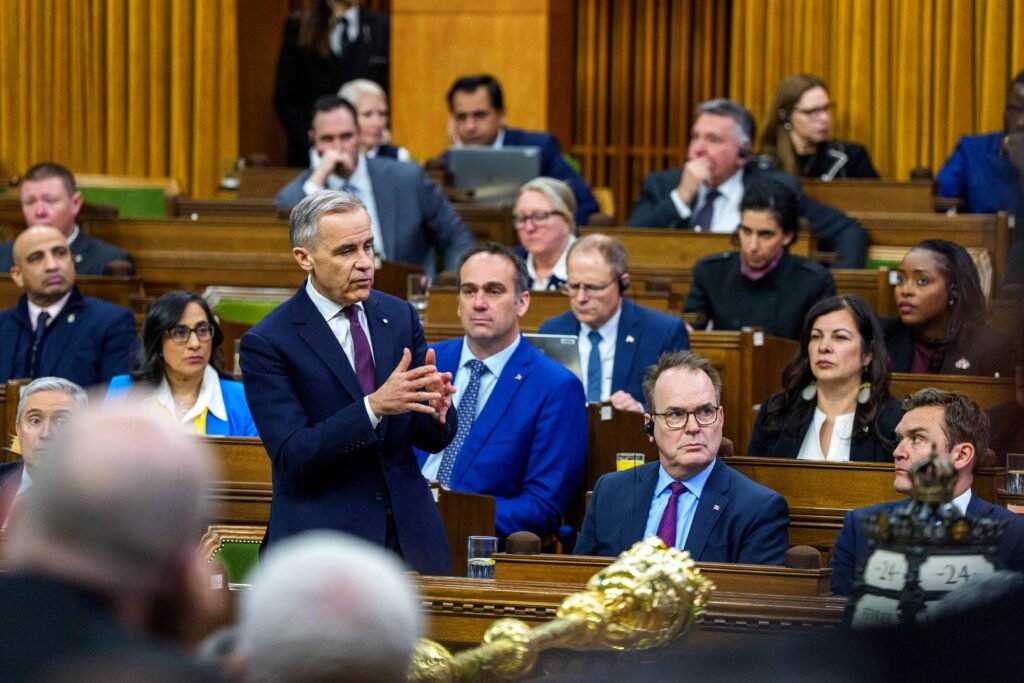
By-elections are typically low-stakes events that fill individual vacancies, and they rarely collectively shift the balance of power in Parliament. Well, in what has become a year of political surprises, the governing Liberals, led by Mark Carney, secured enough additional seats to move from a minority to a majority government, underscoring how small electoral changes can have outsized institutional consequences in Canada’s parliamentary system.
Majority Status: A Rare Mid-Parliament Shift
Following the by-election victories in Terrebonne (Quebec), University–Rosedale (Ontario), and Scarborough Southwest (Ontario), Prime Minister Carney now leads a majority government. By winning all three contested ridings, while also benefiting from recent floor crossings in Parliament, the Liberals crossed the 172-seat threshold required for majority control in the House of Commons.
This outcome is highly unusual. In most cases, majority status is determined during a general election, not between elections. However, Canada’s first-past-the-post electoral system, coupled with the relatively small margins of support between parties, mean that even a few seat changes can dramatically alter governing status. Additionally, the parliamentary system allows for shifts in party alignment without requiring a new national vote, which further enables this kind of transition.
Election Timing: Stability Restored but Strategic Temptations Remain
The shift to a majority government has immediate implications for the timing of the next federal election. Under Canada’s fixed-date election law, the next vote is scheduled for 2029. However, this timeline is flexible in practice, particularly under minority governments, where elections can be triggered early by a loss of confidence in the House.
With a majority, that instability disappears. The Carney government no longer depends on opposition support to survive confidence votes and can govern securely for a full term. As a result, the likelihood of an early election has dropped significantly. In effect, these by-elections have “reset the clock,” providing the government with a stable legislative window that could last several years.
At the same time, the political incentives are more complex. By-election victories often generate short-term positive momentum in public opinion, and early indications suggest this may benefit the governing Liberals. If this momentum widens the polling gap between the Liberals and the Conservative Party of Canada, particularly given how closely the two parties had been tracking prior to the by-elections, it could create a strategic temptation.
Majority governments still retain the prerogative to call early elections. If favourable polling conditions persist, the Carney government could seek a fresh mandate to consolidate its position further. While there is no institutional necessity to do so, the combination of momentum, opposition disarray, and newly secured governing authority creates a classic window in which governments sometimes choose to go back to voters on their own terms.
Implications for Opposition Parties
The results represent a clear setback for opposition parties. In a minority Parliament, opposition groups can exert meaningful influence by threatening to defeat the government on key votes. That leverage has now been eliminated. Without the ability to trigger an election or extract concessions through confidence votes, opposition parties must shift their focus.
In the short term, they face narrative challenges, particularly after failing to gain ground in public opinion. In the longer term, the extended timeline before the next election forces a strategic pivot toward rebuilding party support, refining policy platforms, and strengthening leadership positions. The political arena shifts from immediate tactical maneuvering to a longer-term contest over public opinion.
Conservative Party Challenges: Strategic Drift and Mixed Signals
The by-election results expose deeper strategic challenges for the Conservative Party of Canada. One notable complication is the mixed messaging emerging from within the broader conservative movement. For instance, Doug Ford publicly suggested that a Carney majority could provide stability, an argument that undercuts federal Conservative efforts to portray the Liberals as unfit to govern.
This creates a coherence problem: when a prominent conservative premier appears to validate the governing Liberal party’s mandate, it weakens the opposition’s national narrative and blurs partisan lines for voters. It also suggests a tension between provincial pragmatism and federal opposition strategy, leaving the party without a clear, unified message.
More broadly, the failure to convert these by-elections into gains raises questions about voter resonance, campaign targeting, and leadership positioning. With a now-secure majority government, Conservatives lose their most immediate leverage and must instead recalibrate for a longer electoral horizon, one that demands clearer policy differentiation for a future election and stronger national messaging.
NDP Dynamics: A Short Grace Period for New Leadership
For the New Democratic Party, the disappointing results are partially mitigated by leadership transition. Avi Lewis, as a new leader, can reasonably be given some latitude for early electoral underperformance.
However, that grace period is likely to be brief. By-elections often serve as early tests of leadership effectiveness, organizational capacity, and message clarity. Continued weak showings could quickly erode internal confidence and public credibility. Compounding this challenge is a structural issue: Lewis does not currently hold a seat in the House of Commons, which limits his visibility and ability to directly engage in parliamentary debate. As a result, a key near-term priority for the party will be to secure a seat for its leader, but it is not very clear how and where this opportunity might be seized.
The party therefore faces a dual challenge. It must rebuild electoral relevance while also establishing its leader within Parliament and the broader public. And, the party must do this under conditions where the next electoral opportunity may be several years away.
Electoral System Peculiarities Highlighted
These by-election results illustrate several distinctive features of Canada’s electoral system. First, they demonstrate how small seat changes can produce disproportionate political effects, especially in closely divided parliaments. Second, they show that by-elections, which are usually followed most closely by pundits and party hacks, can become critical inflection points when parliamentary margins are tight.
Third, the episode highlights the flexibility of fixed election dates. While Canada formally schedules elections at regular intervals, the practical timing is heavily influenced by parliamentary dynamics. Finally, it raises broader questions about democratic legitimacy, as a government can obtain full majority authority without a general election, relying instead on incremental electoral outcomes and parliamentary rules.
A further implication is the likely effect on electoral reform debates. This episode reinforces long-standing criticisms of the first-past-the-post system, namely, that it can produce disproportionate outcomes from marginal vote shifts and confer significant governing power without a broad, renewed popular mandate. Reform advocates may use this case to argue for alternatives such as proportional representation, which would reduce the likelihood of such abrupt power shifts.
At the same time, the outcome may weaken reform momentum in the short term. Majority governments, especially those that benefit from the existing system, have historically shown little incentive to pursue structural electoral change. As a result, while the by-elections may intensify the argument for reform, they simultaneously reduce the political likelihood of reform being implemented in the near future.
Key Points
The April 2026 by-elections have had an outsized impact on Canada’s political landscape. By converting a minority government into a majority, they have stabilized governance, reduced the likelihood of an early election, and weakened the immediate influence of opposition parties. At the same time, they expose internal challenges for both Conservatives and the NDP, particularly around leadership, messaging, and long-term strategy. More broadly, they serve as a clear example of how Canada’s parliamentary system allows significant shifts in political power to occur outside general elections, reflecting both its flexibility and its complexity.